


Why Founders Make Bad Decisions When They're Tired (And What to Do Instead)

Updated: Apr 17
You've been here before.
It's late. Or it's the third meeting of the day. Or you've just had a difficult conversation that didn't go the way you planned.
And now, sitting in front of you, is a decision that matters. Something about a partnership, a pivot, a hire, a direction. Something that will have consequences either way.
And you can't think clearly. Not because you're not smart enough. Not because you don't have enough information. Because you're tired.
The problem isn't the decision. It's the state you're deciding from.
Most of us approach decision-making as a thinking problem. We make lists. We build spreadsheets. We ask other people what they would do.
But research on cognitive fatigue tells us something uncomfortable: the quality of our decisions degrades significantly when we're depleted — not just in accuracy, but in the type of decision we make.
Depleted people tend to default to the status quo, overweight short-term consequences, mistake urgency for importance, and choose based on what reduces discomfort rather than what's actually aligned.
In other words: tiredness doesn't just make you slow. It makes you make different decisions — ones you often regret. For founders, this is particularly acute. You're making high-stakes decisions constantly, often without adequate support, often under financial pressure, often while managing a team's wellbeing alongside your own.
What happens physiologically
When you're fatigued, your nervous system is dysregulated. Your prefrontal cortex — the part responsible for long-term planning, nuanced thinking, and values-based choices — has less available bandwidth. What takes over? The more reactive, threat-detection parts of your brain.
This is why a decision that feels impossible at 10pm can feel completely clear at 9am. The decision hasn't changed. Your state has.
Clarity is not a thinking problem. It's a state problem.
The trap founders fall into
The common response to decision fatigue is to push through. More research, more thinking, more coffee. But pushing through a dysregulated nervous system doesn't restore clarity. It deepens the rut.
The other common response is to delay indefinitely — to keep the decision "open" while hoping something will shift. Sometimes this works. Often it just means the decision gets made by default when circumstances force it. Both responses treat the symptom rather than the cause.
What actually helps
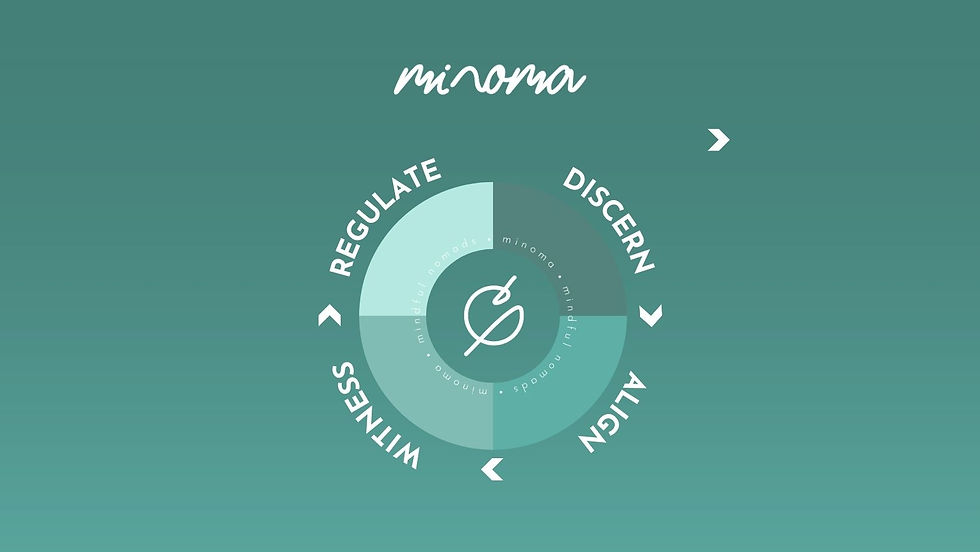
The most reliable way to make a good decision when you're depleted isn't to think harder. It's to regulate first. Regulation means bringing your nervous system back to a baseline where nuanced thinking is actually available. This doesn't require hours — it can happen in minutes if done deliberately.
A few rounds of slow inhale, longer exhale activates the parasympathetic nervous system within minutes. Noticing what you can feel, hear, and see brings you back to the present. Mentally removing the false deadline creates space for a different quality of thinking. And asking "what feels true right now, with no pressure?" engages a different part of your cognition.
The pattern we see at MINOMA
After 36 retreats and working with over 250 founders and professionals, one thing is consistent: the decisions people make during the retreat — from a regulated, unhurried state — are rarely the same decisions they arrived planning to make.
Not because they got new information. Because they were in a different state when they made them. Someone arrives thinking they need to scale. They leave having decided to simplify. The decision was always there. The state to access it clearly wasn't.
A place to start
We created a free 10-minute guided audio — the MINOMA Decision Reset — as a starting point. It walks you through the first step of this process: regulation before decision. Most people are surprised by what becomes clear in ten minutes of deliberate stillness.
If you want to go deeper with a real decision, our live Decision Sessions take you through the full four-step process in 75 minutes.
Maris Kohv is the founder of MINOMA, a decision clarity practice for founders and professionals navigating important life and business transitions. MINOMA has hosted 36 retreats across Europe and Morocco since 2019.


Comments