


The Founder's Guide to Making Decisions Under Pressure

Updated: Apr 20
Pressure changes how you decide.
Not just the speed of decisions, or the confidence behind them - the actual decisions themselves.
What you choose when you're under pressure is often meaningfully different from what you'd choose from a regulated, unhurried state. And most founders are operating under pressure almost continuously.
This isn't a personal failing. It's physiology. Understanding it - and working with it rather than against it - is one of the most practical things a founder can do.
What pressure actually does to decision-making
When you're under sustained pressure, financial stress, team conflict, growth demands, uncertainty about direction, your nervous system activates a threat response.
This is evolutionary and largely... automatic.
The result is a measurable shift in cognitive function. Your prefrontal cortex, responsible for nuanced judgment, long-term planning, and values-based decision-making, loses bandwidth. Your amygdala - the threat-detection and reactive part of your brain - takes over more of the processing.
In practical terms, this means: you overweight short-term consequences and underweight long-term ones. You default to what's familiar rather than what's genuinely optimal. You're more likely to make decisions that reduce the immediate discomfort of uncertainty rather than decisions that are actually aligned with your values and goals.
You're also more likely to mistake urgency for importance. Under pressure, things that feel urgent consume the same cognitive resources as things that are genuinely important... and there's no internal signal to distinguish them.
The founder-specific pressure stack
Most founders carry a particular kind of pressure that compounds these effects.
It's not just the volume of decisions... it's the isolation they're made in, the weight of consequences for other people, and the absence of anyone to distribute the cognitive load to.
There's also what I'd call performance pressure - the sense that as the founder, you should be able to figure this out. That needing more time, more space, or more support is somehow a sign of inadequacy rather than an accurate read of the situation.
This layer of pressure is often the most corrosive. It's not the external demand that blocks clarity — it's the judgment about needing clarity in the first place.
The three most common pressure-driven decision patterns
After working with founders over 36 retreats, three patterns appear consistently in people who are deciding under sustained pressure:
The momentum decision. You continue on the current path not because it's right, but because changing it would require a decision and decisions are costly when you're depleted. The status quo wins by default. In retrospect, people often describe these as "decisions that made themselves" — which is accurate, in a sense.
The relief decision. You make a choice primarily to end the discomfort of not having made it. The decision isn't wrong, necessarily - but the primary driver was relief, not alignment. These often hold for a while and then gradually lose their conviction.
The consensus decision. You ask enough people what they think until you have permission from external sources to proceed. This can look like good process and sometimes is — but under pressure, it's often a way of offloading the responsibility of deciding to people who don't carry the consequences.
A practical framework for deciding under pressure
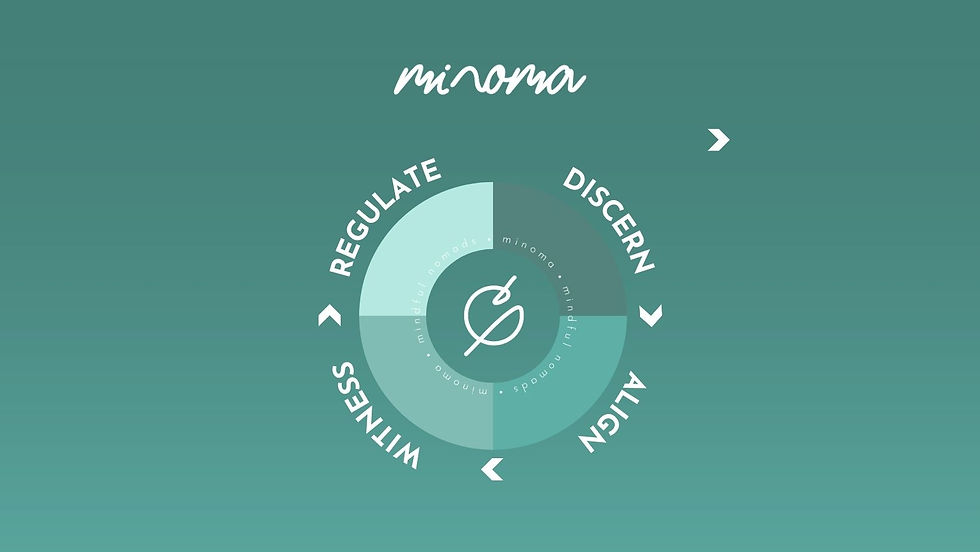
The core principle is simple but not easy: regulate first, then decide.
Step 1: Question the urgency.
Most decisions that feel urgent aren't. Before engaging with the substance of the decision, ask: what actually happens if this isn't decided in the next 24 hours? In the next week? Often the deadline is internally generated by the discomfort of uncertainty, not by external reality.
Step 2: Regulate before you engage.
Slow breathing — a longer exhale than inhale — activates the parasympathetic nervous system within minutes. Physical movement. Even brief time outside. The goal is to create a measurably different starting point for the decision.
Step 3: Separate the decision from the pressure.
Ask: what would I decide if there were no external pressure at all? If no one was watching, no one was depending on this, no financial consequence was attached — what feels true? This question doesn't give you the decision, but it gives you a clearer read on where your actual preference lies.
Step 4: Notice what your body says.
From a regulated state, your somatic response to each option is more reliable. Imagine you've chosen option A — not as an analysis, but as a physical imagining. Let it settle. Notice what happens in your body. Then do the same for option B.
When the pressure is structural
The steps above help with acute pressure. But many founders are operating under a chronic pressure that isn't addressed by a single intervention. When the pressure is structural — built into the way you work, the stage of your company, the demands of your role — the solution is structural too.
This is where creating a genuine break — not a holiday, but a structured space specifically designed to reduce cognitive load and restore decision-making capacity — becomes relevant. Not as a luxury, but as a maintenance requirement for sustainable high-quality judgment.
Start here
If you're currently navigating a decision under pressure, the most useful immediate step is regulation before analysis. The MINOMA Decision Reset is a free 10-minute guided audio built specifically for this.
If you'd like to work through a specific decision with guidance — in a live, small-group setting with the full four-step process — the MINOMA Decision Sessions are free for now.
Maris Kohv is the founder of MINOMA, a decision clarity practice for founders and professionals. She has hosted 36 retreats since 2019 and works with founders navigating high-stakes decisions and transitions.


Comments