


When Logic Gives You an Answer But Your Body Says No

Updated: Apr 20

You've done the analysis.
The spreadsheet makes sense. The strategic rationale is solid. Every advisor you've spoken to agrees it's the right move.
And yet. Something is off. A quiet resistance you can't quite articulate. A heaviness when you think about committing. A sense that even though this looks right, it doesn't feel right.
Most founders have experienced this. Few know what to do with it.
The trap of pure rationality
We're trained, especially in business, to trust logic. Numbers, frameworks, data, external validation. These are the accepted currencies of good decision-making. And they're valuable — genuinely.
But logic has a limitation that doesn't get talked about enough: it can only work with the inputs you give it. What it can't do is tell you what you actually want. When logic and intuition conflict, it's often because logic is answering a different question than the one that actually matters.
What the body is doing
Neuroscience research on interoception has been building the case for something practitioners have known for decades: the body holds information the conscious mind doesn't have direct access to.
Your nervous system is constantly processing inputs below the threshold of conscious awareness. It picks up on patterns, incongruences, misalignments — and communicates these through physical sensation. The tightening in your chest when you imagine a particular path. The sense of expansion when you consider another. These aren't random. They're signal.
The problem: distinguishing signal from noise
Not every physical sensation is useful information. Sometimes the tightness is fear of something genuinely good but unfamiliar. Sometimes the resistance is avoidance dressed up as intuition.
This is where most "trust your gut" advice falls short. The real skill is learning to distinguish fear of genuine misalignment from fear of uncertainty, and avoidance of something difficult but right from accurate recognition that something is wrong.
These feel different when you're regulated and paying close attention. They feel identical when you're depleted and reactive. Which is exactly why nervous system state matters so much.
A different way to approach the conflict
When you find yourself in the logic-vs-body conflict, a few things tend to help. Slow down before you decide — the urgency you feel is almost always greater than the actual deadline. Sit with both options deliberately in a physical way: imagine you've chosen option A, let it settle, notice what happens in your body, then do the same for option B.
Ask what the resistance is protecting. Sometimes the body is saying "this is wrong." Sometimes it's saying "this will require a change you're not sure you're ready for." Getting curious rather than reactive helps separate them. And before anything else — get regulated first.
What we work with at MINOMA
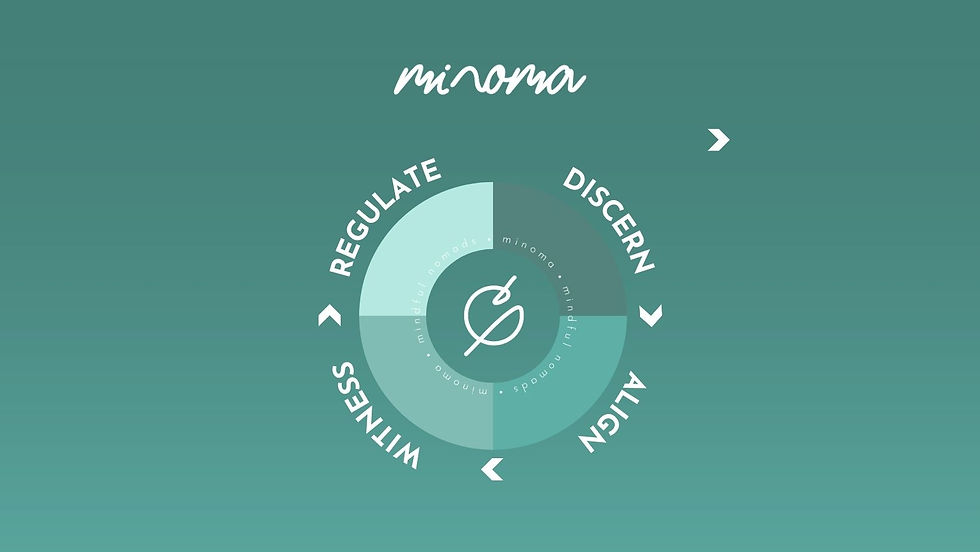
The third step of the MINOMA Decision Method is what we call Alignment — the process of separating fear, pressure, and external expectation from what's genuinely true for you. It's the step where the logic-vs-body conflict tends to resolve.
Repeatedly, people leave this step having made a decision they trust — sometimes the logical one, sometimes the intuitive one, sometimes a third option they hadn't considered. The point isn't which decision. The point is the quality of certainty from which it's made.
Start here
If you're in the middle of one of these conflicts right now — where the head and body aren't agreeing — the most useful place to start is getting regulated.
The free MINOMA Decision Reset is a 10-minute guided audio that walks you through exactly this: creating a physiological baseline from which the signal is more accessible.
If you'd like to work through a specific decision with guidance, the MINOMA Decision Session takes you through the full method in a live, small-group setting.
MINOMA runs decision clarity retreats and sessions for founders and professionals navigating important life and business transitions.


Comments